Where it began
eduActiv8 began in December 2011 as a very personal project.
My son needed a bit of extra support with early maths and language skills. Like many children, he learned best through curiosity and play.
So I started building small interactive activities to help him explore those areas in a more engaging way — written in Python and Pygame, running on whatever computer was to hand. What began as a handful of exercises gradually grew into something much larger.
Seeing those early activities help my son gain confidence — and eventually develop a real enthusiasm for maths — was the experience that shaped everything that followed.
A family project
From early on, the project benefited greatly from the input of my wife, Kamila, a Psychology graduate. Her perspective helped ensure that the activities were not only educational, but also intuitive, age-appropriate, and genuinely engaging for young learners — built around how children actually think and learn, not just how an engineer imagines they might.
The project also had a personal dimension for me. Working on it deepened my interest in software development, and I went on to successfully complete a degree in Computing and IT. In a real sense, eduActiv8 was not just a learning tool for my son — it became part of my own education too.
From personal tool to shared resource
The project was originally called pySioGame, and it was never intended for public release. That changed in April 2012, when I was encouraged by a friend to share an early version on SourceForge.
The response was immediate and encouraging. Within weeks, the first community contributions began to arrive:
- Miriam Ruiz contributed the first external translation — Spanish — in November 2012, along with Debian and Ubuntu packaging
- Anton Kayukov contributed a partial Russian translation that same month
- The Linux Mint Greek Community contributed a Greek translation shortly after
- Users began submitting bug reports, suggestions, and ideas for new activities
It quickly became clear that this was no longer just a personal tool. Other families and educators were finding it useful, and a small but dedicated community was beginning to form around it.
Growth and development
Over the years that followed, pySioGame — later renamed eduActiv8 — grew substantially. Development was active and iterative, with meaningful releases arriving regularly from 2012 through to 2020.
Some of the more significant changes along the way:
- A login system and user profiles were added in 2013, along with automatic locale detection and a local SQLite database for progress data
- Colour accessibility modes were introduced in early 2014, designed for children with colour vision differences
- In January 2015, activities were grouped by age suitability — a small but important change that reflected a clearer educational philosophy
- macOS support arrived in September 2017, alongside the Lakota and Serbian translations and a shift to an XML-driven menu system
- A complete menu redesign in December 2018 replaced the old scrolling menu with a full-screen activity selection screen, and introduced the theme editor
- Right-to-left language support, added for Hebrew in 2014 and later extended for Arabic in 2020, made the application accessible to a wider audience
- The project was included in several Linux distributions, including Debian, Ubuntu, and Mageia
In September 2017, the project was officially renamed from pySioGame to eduActiv8 — a name that better reflects its purpose and the community it serves.
Project timeline
Key moments in the development of pySioGame and eduActiv8.
The project today
eduActiv8 has now been in development for more than fourteen years. While development is no longer as active as it once was, the project remains available and continues to be used by families and schools around the world — including in special education settings.
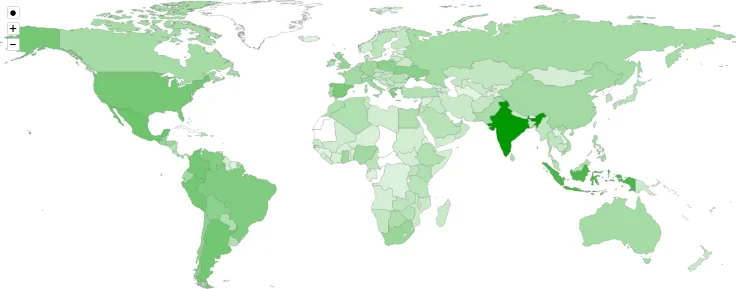
Map showing where eduActiv8 has been downloaded from, since the rebrand in 2017.
It has passed 100,000 total downloads on SourceForge, and has been recognised with multiple community awards, including the SourceForge Community Leader award in 2025 and the All Digital School Editors' Pick Award in 2020.
Rather than constantly changing, its focus has always been on providing a stable, distraction-free environment for learning — something that works reliably every time you open it, without needing an internet connection or an account.
The project also inspired a separate mobile effort: two iOS apps — eduActiv8: Language Arts and eduActiv8: Math & Science — were developed independently by an external team using Lua and the LÖVE framework, funded by the Lakota Language Initiative of the Thunder Valley Community Development Corporation and Elon University. These are distinct from the desktop application but share its educational spirit. More information is available at hackranch.com.
What it represents
At its core, eduActiv8 reflects a few straightforward ideas about how educational software should work — ideas that shaped it from the very beginning and have remained constant throughout.
Thank you
eduActiv8 would not exist in its current form without the support of many people over the years.
Thank you to everyone who has contributed — whether through translations, testing, packaging, bug reports, feedback, or simply using the project and sharing it with others. Your help has made it possible to keep this resource free, open, and accessible to families and schools around the world.
If you would like to get involved — whether by contributing a translation, testing, or anything else — you are very welcome.